

Few nostalgic artifacts capture the spirit of the early era of personal computing as clearly as the humble floppy disk. Introduced in the early 1970s, these thick rectangles became the default way to store and transfer digital information for more than two decades before CDs and USB drives made them obsolete. During that period, probably tens of billions were produced. Today, most of those floppy disks slowly decompose in distant landfills, moldy garages, or long-forgotten storage boxes.
Abandoning those floppy disks entirely risks relegating decades of scientific research, government records, software, and personal correspondence to the dustbin of history. But recovering all the data stored on floppy disks is much more complicated than simply plugging in an old drive. Floppy disks came in various sizes and dozens of incompatible formats. And as hardware capable of reading them fails and disappears, some warn that large amounts of early digital history could fall into a “Digital Dark Age.”
Leontien Talboom, archivist at Cambridge University Library, has spent the last few years working to prevent that from happening. Working with retro computing enthusiasts who have created specialized floppy disk imaging tools, he has recovered data from hundreds of historically important disks in the library’s collection, including previously inaccessible lectures by physicist Stephen Hawking.
As part of the university’s Future Nostalgia project, Talboom recently helped publish a comprehensive guide to obtaining floppy disk images for preservation (aptly called Copy that floppy!), a step that could give archivists and hobbyists around the world a fighting chance to rescue data before magnetic disintegration renders it unreadable.
“I’m not the only one doing this within my community, but I was the only one who posted about it online and it made me feel like, wait, am I really the only one talking about this?” Talboom account popular science. “Does no one else see this as a problem? Why is no one talking about this?”
It may not seem like it now in the world of terabyte hard drives and seemingly infinite cloud storage, but floppy disks were surprisingly durable. Certain aspects of the medical and airline industries still use floppy disks to run critical upgrades on older hardware. Until 2019, the US military was still using an 8-inch floppy disk as a central component to manage its nuclear weapons arsenal. The Japanese government still required floppy disks for some government administrative purposes as recently as two years ago, even though the last major record manufacturer (Sony) stopped producing them more than a decade earlier.
Although imperfect, floppy disks were relatively cheap and durable, which helped them achieve mass adoption. Instead of investing the time and money necessary to modernize older systems with new storage technologies, many institutions simply continued using floppy disks, hence their stubbornly long lifespans.
But like any other magnetic storage media, floppy disks degrade over time. Specifically, the layer of iron oxide attached to the disc’s thin plastic film can break down when exposed to heat, moisture, or mold. As that coating deteriorates, the data encoded in its magnetic patterns can become unreadable. If not cared for, the memory on an old floppy disk can simply fade away.
Related: (Japan’s government has (finally) put an end to floppy disks)
Talboom and his colleagues quickly realized that there was no single solution to preserving material stored in relics for decades. Drives came in multiple form factors and were produced by many different manufacturers, often using incompatible formats and encoding methods. Imaging a floppy disk also requires specialized hardware (called a “floppy controller”), but a setup capable of reading one type of disk will not necessarily work for another. Understanding which tool or process to use often meant delving into the history of floppy drive technology and reviewing online forums, a process Talboom likens to “detective work.”
“At that point I thought we were sorted,” Talboom says. “I thought, this has to be easy, we discovered floppy disks.”
“Turns out they were a lot more complicated than what I first saw, which is really fun,” he adds.

Luckily, the archivist was not flying completely in the dark. While major manufacturers had largely stopped producing new floppy controllers, DIY versions persisted in retro gaming communities eager to preserve old games that only existed on floppy disks. Enthusiasts gave their creations colorful names such as “Catweasel” and its successor, “Greaseweazle,” the latter becoming a mainstay of Talboom’s work. After talking to some of the hobbyists, Talboom realized that they were pursuing the same goal as digital archivists: preserving fragile digital history, just for different purposes.
“These people have already invented the wheel,” Talboom says. “Let’s go and talk to them instead of trying to figure it out ourselves.”
The work to save the past.
Obtaining images from long-lost floppy disks is not an entirely digital process. Sometimes archivists have to get their hands dirty. Talboom says that most of the records in the Cambridge Library collection were donated, either by the families of deceased academics or by prominent people nearing the end of their lives. Such drives are often hidden in basements or garages, where they have accumulated layers of mold and dust that must be precisely cleaned before images can be produced. Those floppy disks may have written labels describing their contents, but that’s certainly not always the case. The labels are also not completely reliable. Floppy disks were often reused and overwritten, so just because one may have the words “research notes” on it does not necessarily guarantee that that is what is hidden inside.
“If we have a label that actually says something about the contents of the record and, in some cases, there’s nothing, there’s nothing, just a blank slate, which can make it very, very difficult,” Talboom says.
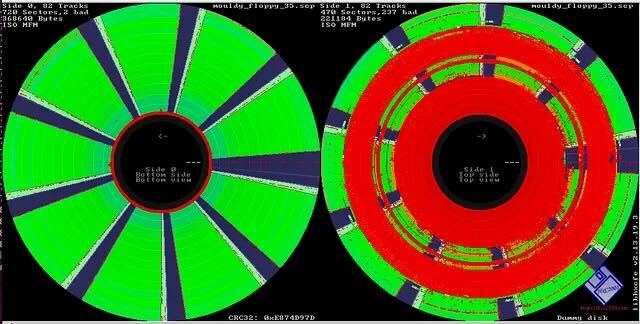
Once clean, Talboom uses its driver belt to read the raw magnetic signals on the floppy disks. This process captures what is called a “flux transition,” the small changes in magnetic polarity that encode the data. The controller interprets these fluctuations and reconstructs them into a format readable by modern software. Talboom says this process is relatively simple for the most common 3.5-inch drives, but becomes more challenging for older or rarer drives.
In some cases, floppy disks have experienced so much magnetic decay that their data is simply unrecoverable, although she says this has happened only a handful of times. The imaging process itself takes only a few moments because the amount of data stored on a floppy disk is minuscule compared to today’s hard drives.
What is really stored on the floppy disks that Talboom has photographed? She couldn’t be too specific due to confidentiality, but says the content runs the gamut. Discs can contain everything from emails, content downloaded from Internet forums, first drafts of books, photographs, and even 3D models. Notably, the library has also not received many floppy disks from the 1990s, when disks were at their peak, suggesting they may have only just begun to scratch the surface of what could be preserved.
“Everything you can think of under the sun will appear on a floppy disk,” says Talboom. “I think that’s the most exciting thing.”
Related: (Yes, the Pentagon still uses floppy disks for nuclear launches)
The project’s completion date is bittersweet for Talboom. She says she’s grateful for the opportunity to bring communities together to save digital history, but she’ll also miss spending so much time with the aging plastic relics. While your primary work with them is coming to an end, it will be up to others to carry out your investigation and ensure that the history stored on the remaining floppy disks is preserved.
“(This project) goes a long way to show how important it is to talk to other communities, because as a community we would never have realized that that would be a good way to store floppy disks,” he adds.

2025 PopSci Best of what’s new